













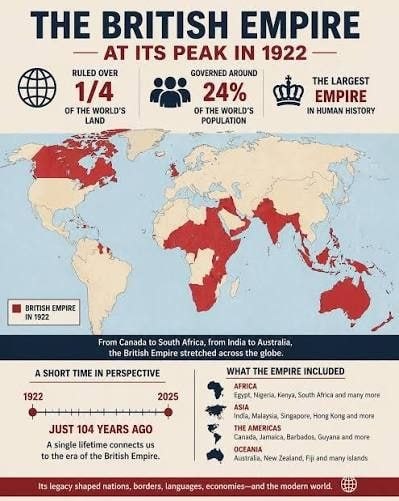
The British Empire at Its Peak (1922)
By 1922 the British Empire controlled 36,190,000 km² — about a quarter of the world's land — and 480 million people, roughly 24% of the world's population.
By 1922 the British Empire controlled 36,190,000 km² — about a quarter of the world's land — and 480 million people, roughly 24% of the world's population.

For a long time the world's population grew very slowly, passing 1 billion only in 1804; two centuries later it reached 8 billion. UN forecasts now expect growth to level off after the 2050s.
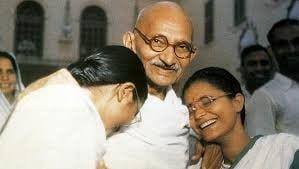
Gandhi on how movements are met, on finding yourself and on the inner voice, with a short note on his role in India's independence movement and his philosophy of non-violence.
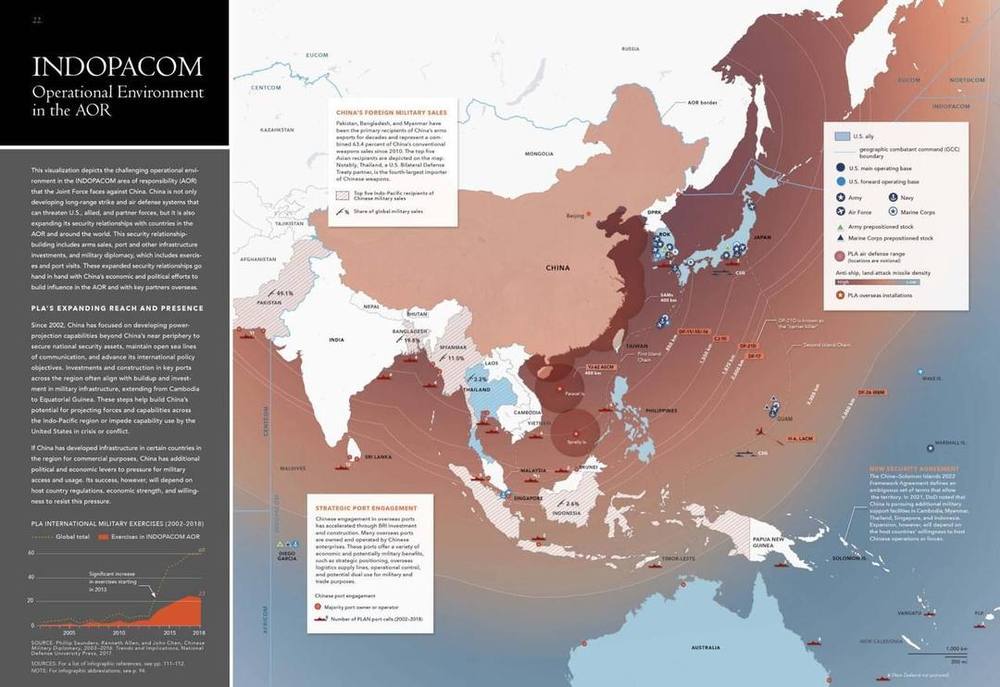
This infographic maps the complex operational picture in the INDOPACOM area of responsibility, where the United States confronts China.
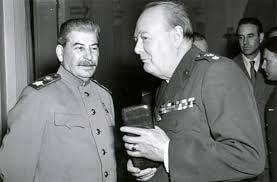
Churchill's famous tribute to Stalin as an extraordinary, ruthless and uniquely capable leader who took Russia with a wooden plough and left it with atomic weapons.
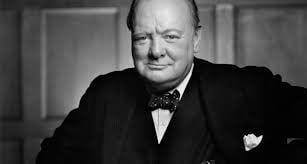
Winston Churchill on perseverance, the speed of a lie, the value of having enemies, and why history holds the secrets of political foresight.
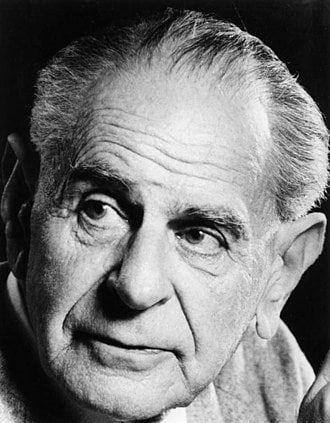
Karl Popper on the danger of utopian designs, the fashion that rules philosophy, and the lessons Plato still offers sociology.

The British diplomat Lord Ponsonby set out the main principles of war propaganda in his 1928 book Falsehood in War-Time.
Ibn Khaldun on why dynasties seldom outlast three generations, and on asabiyyah as the force behind the rise and fall of civilisations.
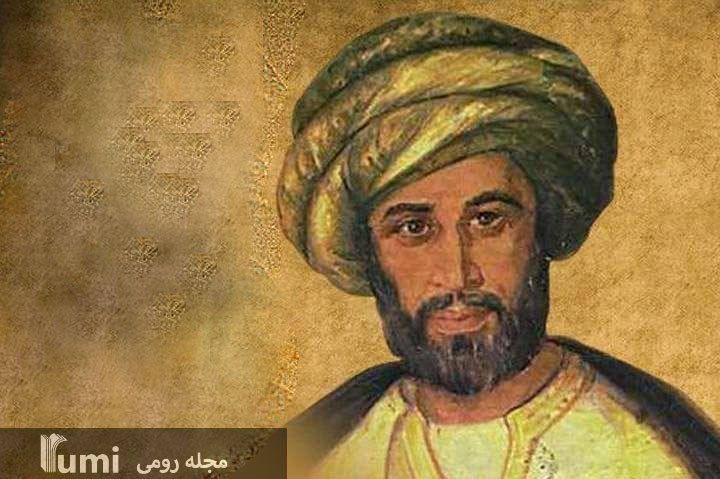
Abdullah ibn al-Muqaffa on self-respect, generosity and the discipline of silence, with an account of the Persian writer who gave Arabic its Kalila and Dimna.
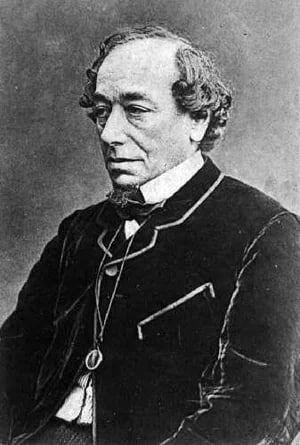
Benjamin Disraeli on doubt and certainty, the power of great thoughts, and the kind of information that decides who succeeds.
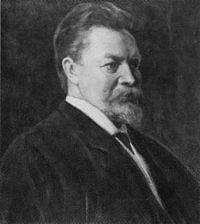
Rudolf Kjellén (1864–1922) was a Swedish geographer and political figure who considered himself a pupil of Friedrich Ratzel. His doctrine treated the state as a living organism and defined the great powers by three spatial factors.
China controls 62% of the global electric vehicle market and holds on to its lead in electric transport.
According to an IMF report, artificial intelligence affects occupations differently: some face a high risk of replacement, others are safe.
The Chagos Archipelago, some 500 km south of the Maldives, hosts the Diego Garcia base, which lets the United States and Britain control sea lanes between South-East Asia, South Asia, the Middle East and Africa. In October 2024 Britain agreed to hand sovereignty over the islands to Mauritius while keeping the base for 99 years.
A further instalment on the thinkers of the German school of geopolitics, this time Friedrich Naumann's wartime vision of a German-led Mitteleuropa.
A genuine gas revolution is under way in US energy, marking a shift to a new technological order in the economy — one in which natural gas is becoming America's main primary energy source.
Rudolf Kjellén (1864–1922) was a Swedish geographer and political figure who coined the term geopolitics. His doctrine treated the state as a living organism and ranked the great powers by space, cohesion and freedom of movement.
According to the International Federation of Robotics, 545,000 industrial robots were installed at factories worldwide in 2022. Asia took 74% of them and China alone 53%.
On 9 September this year former ECB president Mario Draghi presented the European Commission with a report on the future of the European economy, arguing that the EU must mobilise €750–800 billion a year to stay competitive.
Friedrich Ratzel is regarded as the founder of geopolitics as a scientific discipline. His doctrine of the state as a living organism that must expand its living space justified German territorial expansion.
An aircraft carrier is a floating airbase that projects a country's military and economic power at sea. Eleven countries operate carriers today, and NATO members together with Japan have 20 between them.
This chart shows the countries that dominated shipbuilding by gross tonnage of merchant ships built in 2023, led by China, South Korea and Japan, which together account for 94% of the industry.
Halford John Mackinder (1861–1947) was one of the great figures in the history of geopolitics, whose 1904 paper set out the Heartland theory that would shape the field for a century.
The Wakhan Corridor is a narrow strip of land in the Wakhan region of Badakhshan Province in eastern Afghanistan.
A World Bank chart tracing the growth of the world economy over the past two thousand years. World GDP grew by just 20% in the first millennium but has doubled every 20–25 years in recent decades.
According to the IMF, the combined GDP of the G7 reached $45.9 trillion in 2023, one and a half times the size of the BRICS economies.
Bloomberg and IMF forecasts put China first for contributions to global growth in 2024–2029, ahead of the G7 combined, with India second and Indonesia third.
China's outward foreign direct investment by country: the distribution based on fDi Markets data.
Saudi Arabia plans up to 16 nuclear reactors worth more than $100 billion under Vision 2030, following the example of Türkiye, Egypt, Iran and the UAE.
Saudi Arabia ranks 16th by GDP (PPP), and its oil wealth is managed by the state giant Saudi Aramco. The non-oil economy is now growing fast, even as hydrocarbons stay central to modern manufacturing.
Ibn Khaldun's theory of asabiya explains the rise and fall of elites, and it still reads true today. The piece then turns to Saudi Arabia's demography and the mounting pressure of Yemen's population growth.
Poland spends the most on defence of any NATO member, at 3.9% of GDP, while the US is the main beneficiary of rising allied defence budgets.
India is the world's most populous country and its third-largest economy, yet coal still provides more than 80% of its electricity. This chart breaks down Indian power generation by source.