














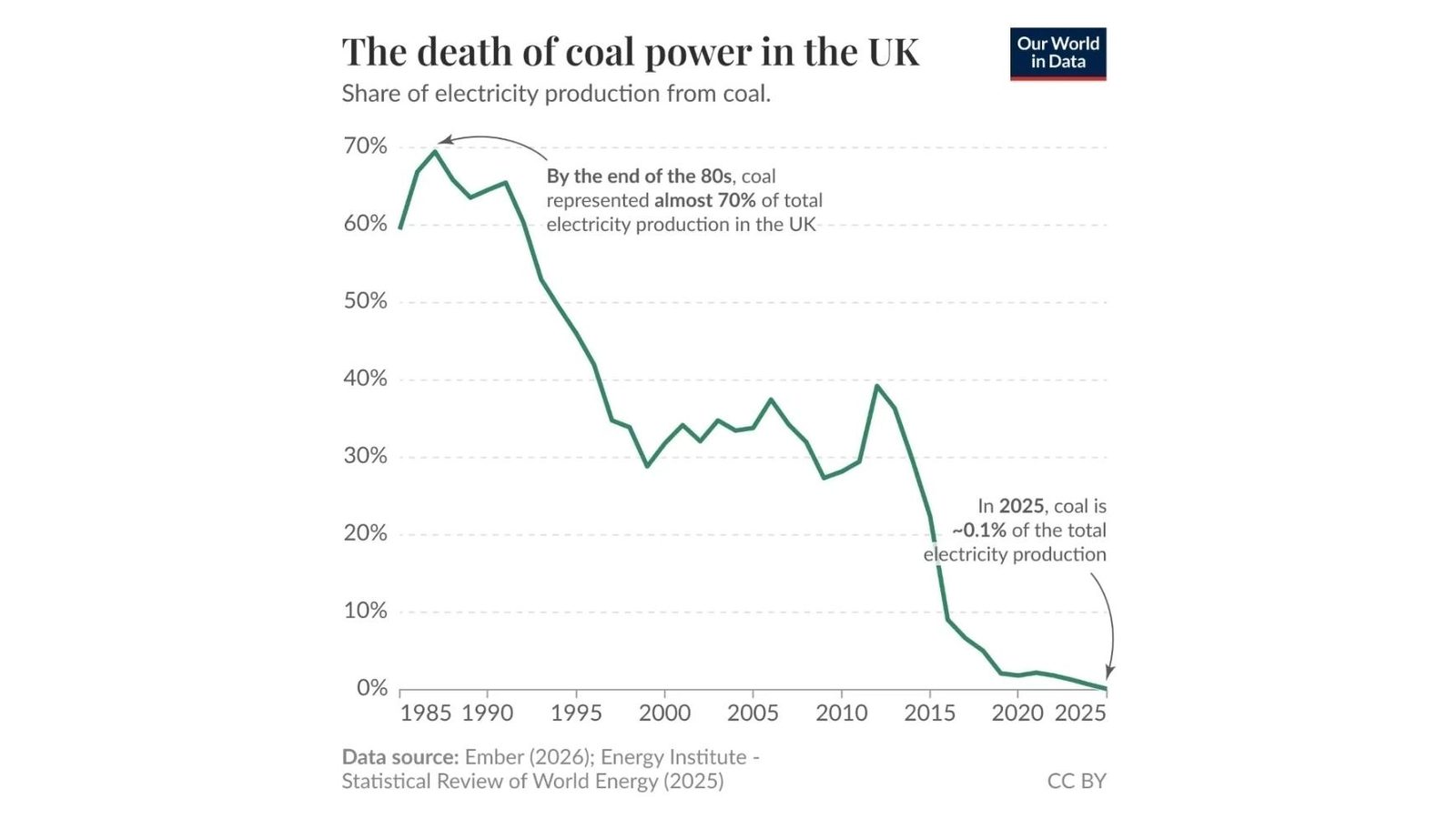
Britain has put an end to coal power. What does it mean for its industry?
In the late 1980s coal produced about 70% of Britain's electricity. It is now the first G7 country to abandon coal generation, which raises hard questions for its industry.
In the late 1980s coal produced about 70% of Britain's electricity. It is now the first G7 country to abandon coal generation, which raises hard questions for its industry.

For a long time the world's population grew very slowly, passing 1 billion only in 1804; two centuries later it reached 8 billion. UN forecasts now expect growth to level off after the 2050s.
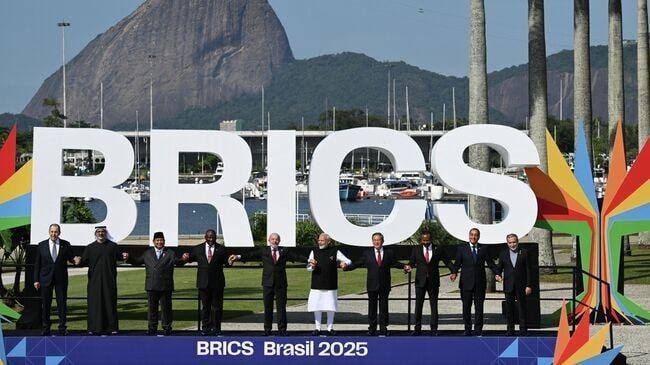
The joint declaration adopted by BRICS at its 17th summit in Rio de Janeiro calls for an immediate, permanent and unconditional ceasefire in Gaza, the full withdrawal of Israeli troops from the occupied Palestinian territories, and a global framework for governing artificial intelligence.
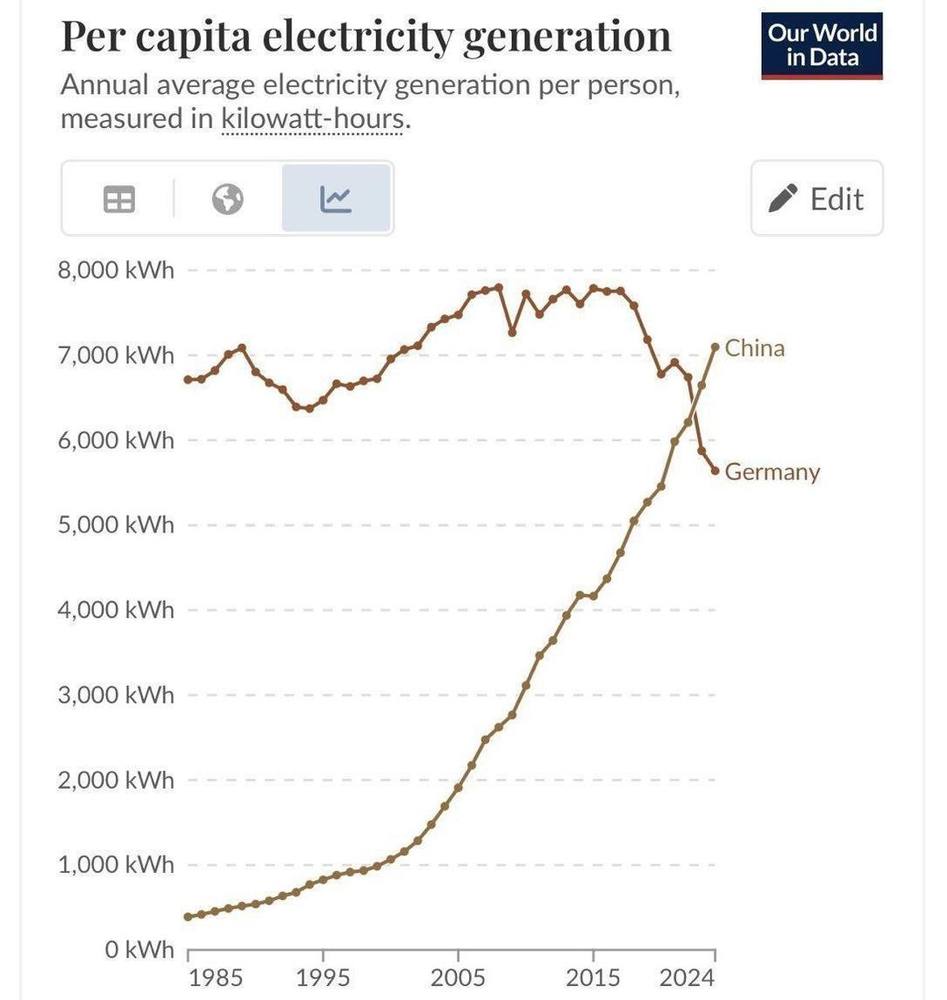
Germany's electricity generation per capita falls year after year, while China's has risen continuously for at least three decades — a sign of where industrial capacity is heading.
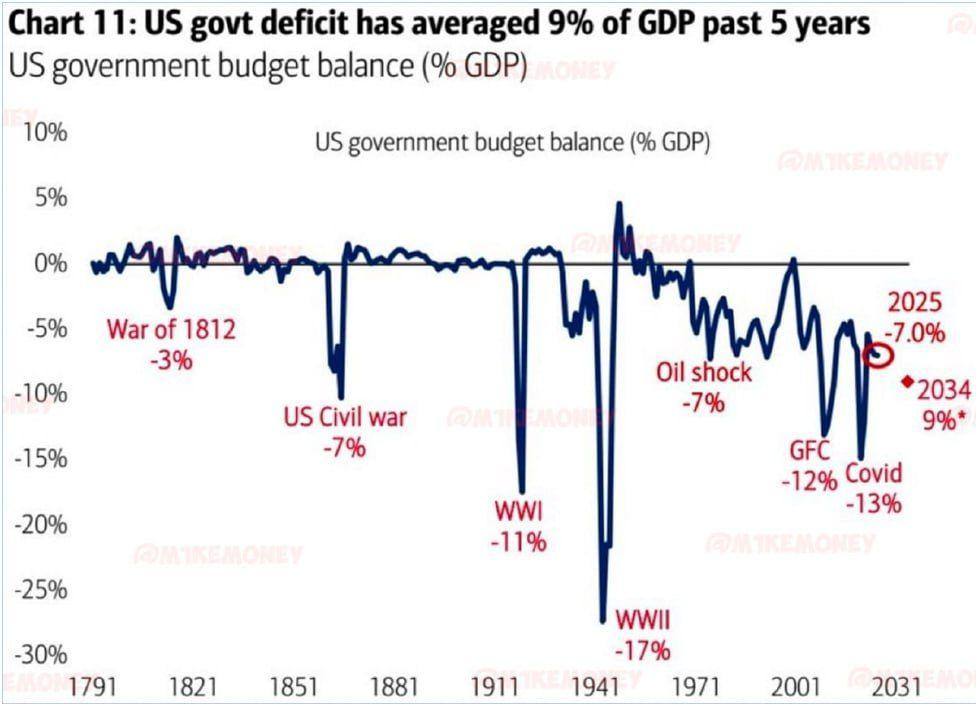
The chart traces the US budget deficit as a share of GDP over more than 200 years of American statehood, from the years before the world wars to the 9% average of the past five years.
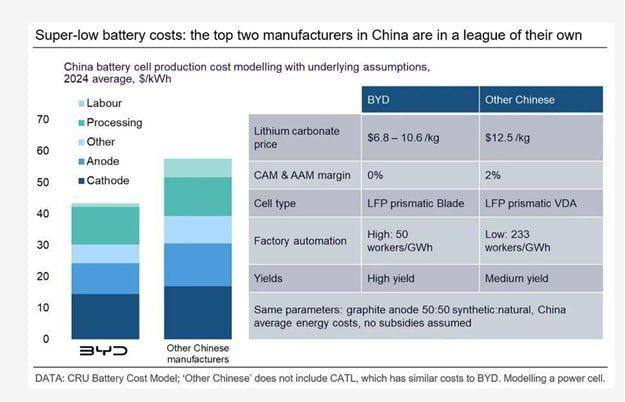
The author's case for why Chinese manufacturers dominate the global solar panel and battery sectors: long-term state industrial strategy, subsidies, self-sufficiency in minerals, scale, automation and cheap electricity.
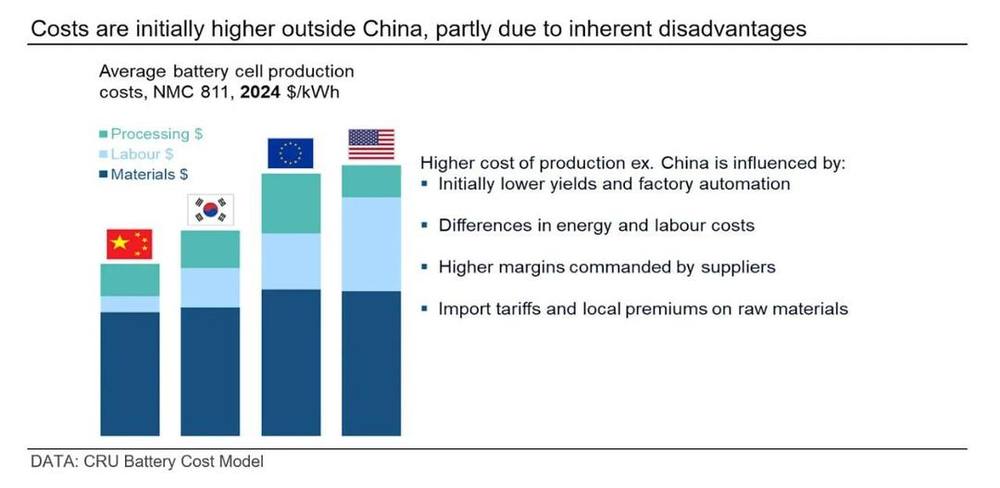
The chart compares the average cost of producing battery cells in China, South Korea, the European Union and the United States, and shows why the US and the EU lag behind China.
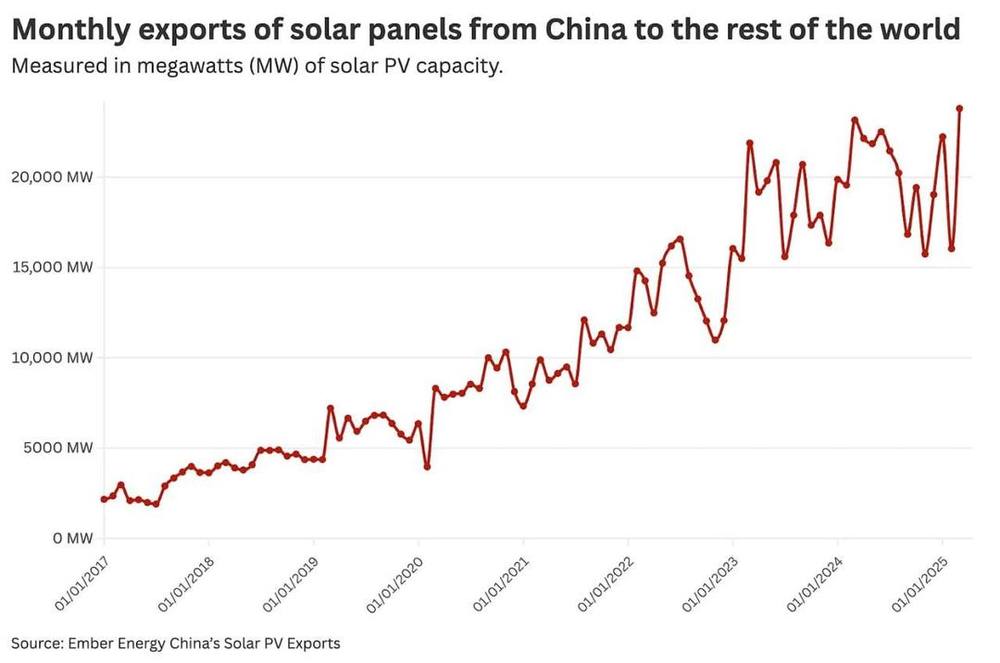
China's monthly exports of solar panels to the rest of the world, measured in megawatts (MW). Chinese panels are far cheaper than those made elsewhere, and China also produces three-quarters of the world's batteries.
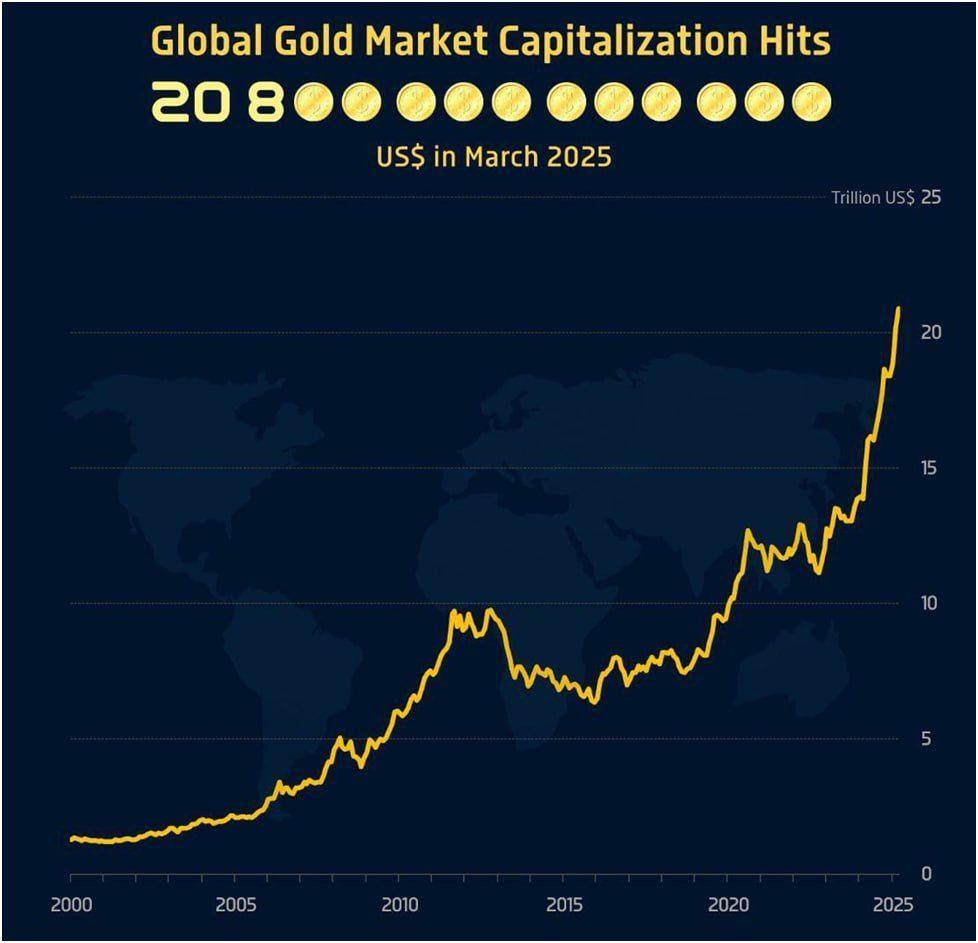
The capitalisation of the global gold market has passed $20.8 trillion, as uncertainty and inflation drive investors towards the metal.
China controls 62% of the global electric vehicle market and holds on to its lead in electric transport.
After Germany abandoned its nuclear programme and closed its plants, German imports of nuclear-generated electricity hit a record in 2024.
In response to the 10% tariffs the United States imposed on imports from China, Beijing introduced additional duties of 15% on US coal and liquefied natural gas (LNG), and 10% on American oil, agricultural machinery, large-engine cars and pickups.
Kazakhstan declined full membership of BRICS at the bloc's October summit in Kazan, choosing instead to watch how the group develops while diversifying its foreign-policy ties and keeping close engagement with the West, The Diplomat reports.
Researchers at the University of São Paulo in Brazil have developed an inexpensive but effective method for stripping micro- and nanoplastics from water, using magnetic nanoparticles that cling to the waste and break it down.
According to the IEA, 83% of the coal mined worldwide is consumed in the Asia-Pacific region, with China alone accounting for more than half of global consumption. India and Indonesia are also increasing their use of coal year after year.
The United States has the world's oldest coal-fired power plants, with an average age set to pass 50 next year, and its 92 nuclear reactors are the third oldest globally. Yet while others build ultra-supercritical coal units, the US is closing its coal plants and switching to gas.
A genuine gas revolution is under way in US energy, marking a shift to a new technological order in the economy — one in which natural gas is becoming America's main primary energy source.
World energy demand will double, driven by the growth of the Global South, the transformation of energy sources and the exponential rise of artificial intelligence.
On 9 September this year former ECB president Mario Draghi presented the European Commission with a report on the future of the European economy, arguing that the EU must mobilise €750–800 billion a year to stay competitive.
Researchers at the University of California, Riverside have found a low-cost way to cut NOx pollution from hydrogen-burning internal combustion engines by making the catalytic converter work better.
The IMF's updated review of the Ukrainian economy suggests the conflict could end in mid-2026, with the debt-to-GDP ratio possibly approaching 300% by 2029 under its negative scenario.
This chart shows the countries that dominated shipbuilding by gross tonnage of merchant ships built in 2023, led by China, South Korea and Japan, which together account for 94% of the industry.
Halford John Mackinder (1861–1947) was one of the great figures in the history of geopolitics, whose 1904 paper set out the Heartland theory that would shape the field for a century.
The fastest-growing economies now lie in Latin America, Africa and Asia, the regions known together as the Global South. Guyana's GDP doubled between 2021 and 2022, and African countries are set for average growth of 6–8% through 2028.
The Cold War divided the planet into three worlds; after the Soviet bloc collapsed, the concepts of the Global North and the Global South took shape.
According to the International Energy Agency, electricity demand in China's economy will grow to 10,498 TWh by 2025, more than double US demand of 4,475 TWh.
According to the US Geological Survey (USGS), identified lithium resources worldwide grew significantly in 2023, to about 98 million tonnes.
A fable by the Georgian writer Sulhan-Saba Orbeliani in which two brothers live side by side, each secretly pouring his own grain into the other's pit.
On 27 May 2024 Russia and Uzbekistan signed a contract for a six-unit small nuclear power plant in the Jizzakh region. The first reactor is due to start up within five years, with full commissioning no earlier than 2033.
According to the US Department of Energy, the United States is the world's largest crude oil producer, pumping almost 13 million barrels a day. This article looks at Texas, the country's energy heartland and second most populous state.
A World Bank chart tracing the growth of the world economy over the past two thousand years. World GDP grew by just 20% in the first millennium but has doubled every 20–25 years in recent decades.
On 13 September 2024 the Bank of Russia raised its key rate to 19%, even as other major central banks were cutting. The increase is feeding through to mortgage rates, which have climbed above 21%.
India has enormous long-term potential for industrial development. Nearly half its working population is still employed in agriculture, and mechanisation will push that labour into the cities and into industry.
According to the IMF, the combined GDP of the G7 reached $45.9 trillion in 2023, one and a half times the size of the BRICS economies.
Saudi Arabia's decision not to renew its era-defining security agreement with the United States, the sale of oil for dollars, reflects both America's declining global influence and where most Saudi oil is now sold.
Bloomberg and IMF forecasts put China first for contributions to global growth in 2024–2029, ahead of the G7 combined, with India second and Indonesia third.
China's outward foreign direct investment by country: the distribution based on fDi Markets data.
Saudi Arabia has yet to pick a builder for its planned reactors, with Rosatom, Westinghouse, KEPCO and CNNC in contention — and it has let the 1974 petrodollar pact with Washington lapse.
Saudi Arabia plans up to 16 nuclear reactors worth more than $100 billion under Vision 2030, following the example of Türkiye, Egypt, Iran and the UAE.
Saudi Vision 2030 aims to wean the kingdom off oil by building up finance, industry, tourism and electronics. Non-oil sectors, including the public sector, now make up half of GDP.
Saudi Arabia ranks 16th by GDP (PPP), and its oil wealth is managed by the state giant Saudi Aramco. The non-oil economy is now growing fast, even as hydrocarbons stay central to modern manufacturing.
Saudi Arabia is OPEC's most important member and a top-three crude producer. Together, OPEC and OPEC+ pump some 46% of the world's oil, which gives them real power over prices.
Ibn Khaldun's theory of asabiya explains the rise and fall of elites, and it still reads true today. The piece then turns to Saudi Arabia's demography and the mounting pressure of Yemen's population growth.
Saudi Arabia is the largest regional power on the Arabian Peninsula and the birthplace of Islam, which arose in Mecca and Medina in the 7th century.
Japan's Sixth Energy Plan targets 38% renewables and 20% nuclear by 2030, while coal and gas lose ground. Yet total power generation has been falling since 2010.
This chart tracks aluminium production in the United States and its share of world output. In the late 1940s and early 1950s the US made more than half of the world's aluminium; today it produces almost none.
India is the world's most populous country and its third-largest economy, yet coal still provides more than 80% of its electricity. This chart breaks down Indian power generation by source.