






World population growth to 2100
For a long time the world's population grew very slowly, passing 1 billion only in 1804; two centuries later it reached 8 billion. UN forecasts now expect growth to level off after the 2050s.
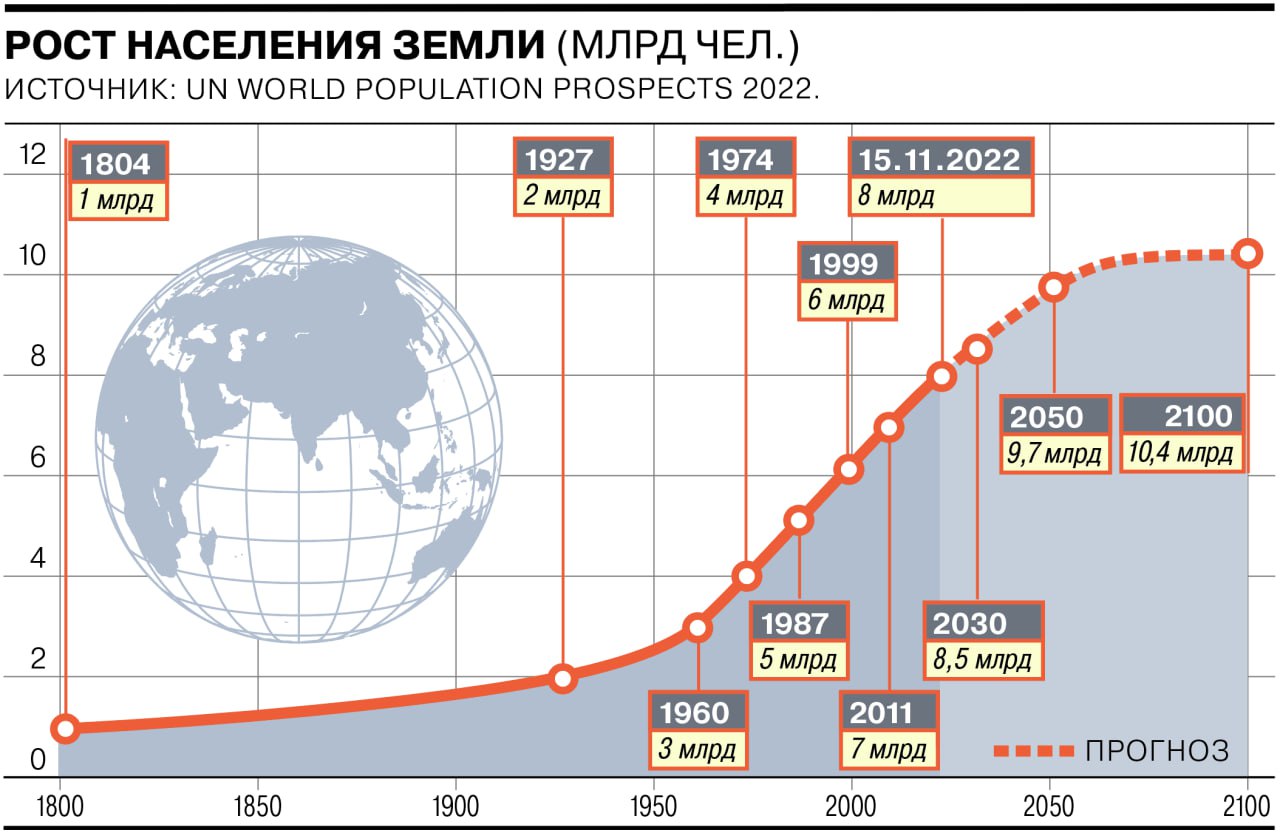
World population growth to 2100.
For a long time the world’s population grew very slowly and passed 1 billion only in 1804. If it took the world 10,000 years to grow from 5 million to 1 billion people in 1804, reaching 8 billion took just two centuries.
The population explosion unfolded across five very important technological orders. The first three (the invention of spinning machines and the rise of the largest factories; the era of coal hegemony and steam-engine technology, with the arrival of locomotives, steamships and so on; and the age of steel, with the invention of the Bessemer converter for mass steel production) can be grouped under the common name of the Great Industrial Revolution, which began in the mid-18th century in Britain, then spread to France and Germany, and later to the United States and Russia.
The remaining two technological orders came later: the age of oil (the mass use of oil in manufacturing and energy, the invention of the assembly line (Ford) and the rapid growth of the car industry) and the age of information technology (computers) and telecommunications, which began in the 1990s.
During these five technological orders the world’s population grew from 800 million (from the 1750s) to 8 billion. The 8 billion mark was reached on 15 November 2022. This population explosion, which unfolded over 200 years, is explained by a substantial rise in life expectancy, itself linked to better nutrition and to advances in sanitation and medicine. Medicine has indeed improved markedly worldwide since then; there is no arguing with that.
Yet the UN forecast suggests that after the 2050s the population will all but stop growing. That forecast is easy to accept. The world’s total fertility rate has indeed fallen from 4.97 births per woman in the first half of the 1950s to 2.3 in 2024, which is close to the minimum needed to keep the population at its current level. Holding a population steady requires a total fertility rate of about 2.1 births per woman over her lifetime.
As I have noted in earlier articles, the world is now entering the sixth technological order, defined by the convergence of AI, biotechnology and nanotechnology. It implies the rapid advance of robotisation, automation and digitalisation of production processes and of every aspect of a society’s social, economic and political life. In my view, this sixth technological order should help address the shortage of population and labour in the countries and regions where a sharp fall in population is forecast.
If the population explosion of the past two centuries is explained by technological progress, better living standards and major advances in medicine, why should the world’s population stop growing after the 2050s, as the UN forecast suggests? That trend cannot be explained by strictly scientific methods, even though we already live in the sixth technological order, which ought to bring further improvements in living standards and still greater advances in medicine. It seems to me that population growth is governed and explained less by material laws than by spiritual ones and by a metaphysics that lies beyond sensory experience, though I may be mistaken.