




Economic growth in the Global South
The fastest-growing economies now lie in Latin America, Africa and Asia, the regions known together as the Global South. Guyana's GDP doubled between 2021 and 2022, and African countries are set for average growth of 6–8% through 2028.
Economic growth in the Global South
The fastest-growing economies in the world today are in Latin America, Africa and Asia, the regions known together as the Global South. Guyana is the only English-speaking country on the South American mainland, lying on the Atlantic coast and bordering Venezuela and Brazil, and was formerly an English colony. Lately it has drawn attention for its explosive growth: between 2021 and 2022 Guyana’s GDP doubled. Experts at the International Monetary Fund predict “explosive” growth of 38% in 2024 and 115% by 2028.
Guyana’s surge is tied to sharply rising oil production and export revenues. Output is forecast to reach 1.2 million barrels of oil a day by 2027. In Guyana a consortium of oil and gas companies (American ExxonMobil with 50%, Chinese CNOOC and American Chevron) holds the largest oil field in the Stabroek project, whose reserves are estimated at 11 billion barrels. Revenue from the oil sector is driving the country’s development, including housing, transport and infrastructure for its people, and growth in services and supply, agriculture and mining.
Of course, Guyana needs to build its own oil company and its own oil and gas technology sector, so that the lion’s share of oil revenue stays at home instead of going to foreign companies and can be channelled into developing and diversifying the economy as a whole.
As for Africa, Mozambique, Rwanda, Ethiopia, Niger, Uganda and Senegal are among the world’s ten fastest-growing developing countries, with impressive average growth of 6–8% over 2024–2028. Africa today is one of the most promising regions in terms of development potential and economic growth. To give a sense of that potential: the continent holds up to 40% of the world’s gold reserves and up to 90% of its chromium and platinum. It has the planet’s largest reserves of cobalt, diamonds and uranium. The Democratic Republic of the Congo, for example, supplies about 70% of global cobalt output.
South Africa, Madagascar, Malawi, Kenya, Namibia, Mozambique, Tanzania, Zambia and Burundi also hold significant reserves of neodymium, praseodymium and dysprosium. Guinea holds 35% of the world’s bauxite reserves. Africa accounts for 65% of the world’s arable land and about 10% of its internal renewable fresh water. An enormous potential!
Economic growth across the Global South will demand vast amounts of energy: oil and gas, new hydroelectric, coal- and gas-fired thermal and nuclear power plants, and renewables. These countries face large-scale urbanisation, meaning the building and expansion of cities, and a major rise in living standards. Fuel consumption will grow, which is why Russia is expanding its presence in Africa, increasing trade and offering infrastructure and energy projects. It is important to understand that Global South economies are growing from a low base, which will sustain stable, long-term growth, whereas the countries of the Global North have already passed their economic peak.
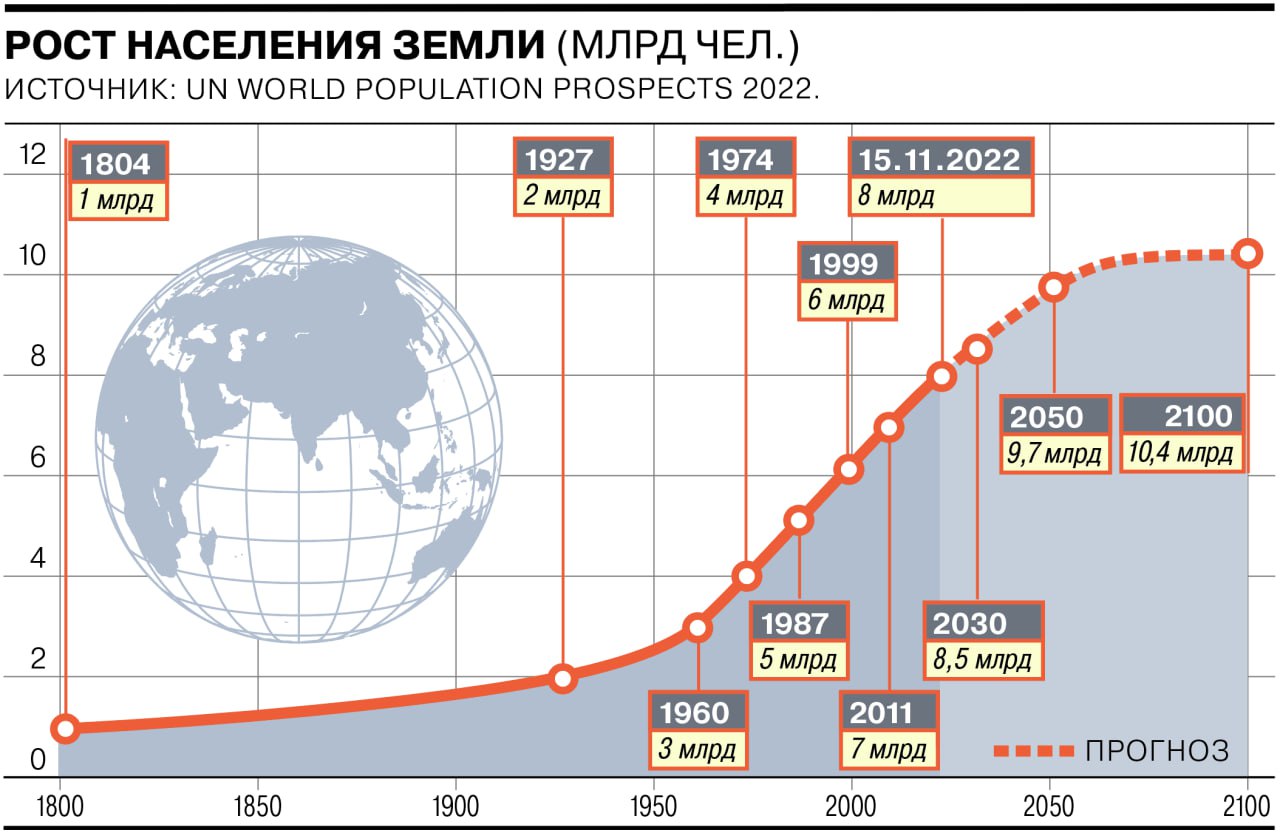
Faster growth in Africa and Asia will raise living standards in those regions and in turn create enormous demand for goods: these countries will absorb everything the world produces. They will plough revenue from resource sales into infrastructure and develop their economies. High birth rates and young populations are another core driver of growth, alongside the expansion of the productive forces. Europe’s stagnating countries, by contrast, are forced to attract large numbers of immigrants to sustain growth, given falling birth rates and labour shortages. The countries of Latin America, Africa and Asia are the new markets!