






China's strategic depth and the clash of its interests with those of the United States in the Asia-Pacific
This infographic maps the complex operational picture in the INDOPACOM area of responsibility, where the United States confronts China.
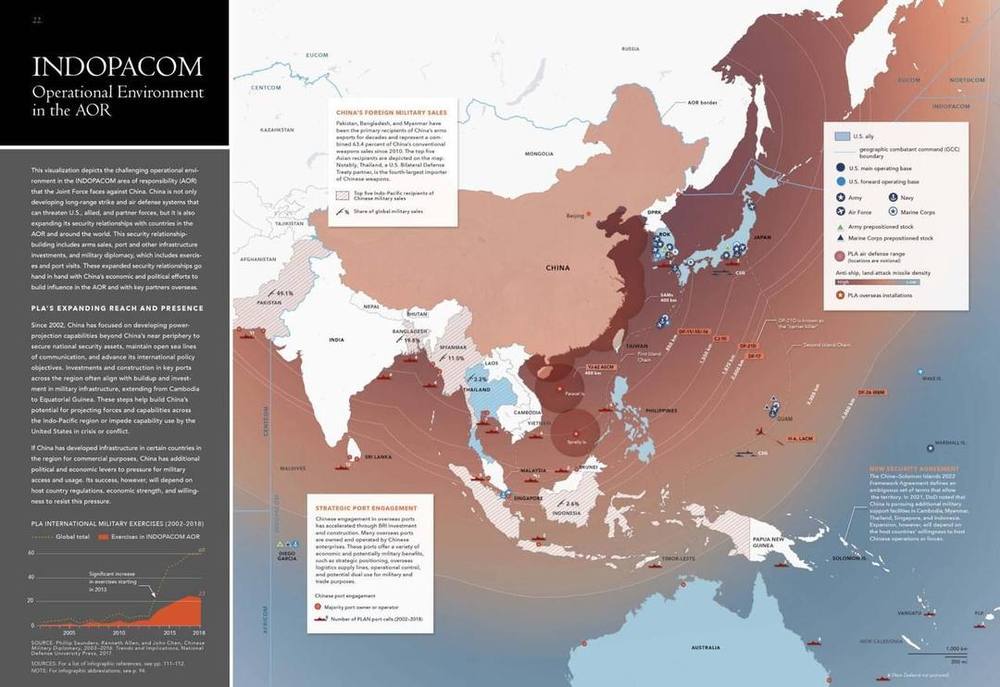
This infographic maps the complex operational picture in the INDOPACOM area of responsibility, where the United States confronts China. The area of responsibility of the United States Indo-Pacific Command (INDOPACOM) covers about half the surface of the Earth, stretching from the waters off the US west coast to India’s western border and from Antarctica to the North Pole. INDOPACOM is responsible for planning operations and commanding American troops in the event of hostilities in the Indo-Pacific.
China is not only developing a long-range strike system (long-range hypersonic missiles) and air defences capable of threatening US, allied and partner forces, but is also expanding its security relationships with countries in the region, in South Asia and around the world. This build-up of security ties includes exercises and port visits. These expanded security relationships go hand in hand with China’s economic and political efforts to strengthen its influence in the regions named and with key partners abroad.
In recent years China has become the world’s leading industrial, trading and financial power, trailing the United States only in the military component. The United States, absorbed by numerous conflicts around the world, lost sight of China. To become the leading global power in every component, China needs strategic depth in the Asia-Pacific region: as the map shows, China is hemmed in geopolitically by US naval and air bases in the region. American military bases sit at the most strategically important points in the Asia-Pacific, including South Korea, Japan, the island of Guam, Singapore and the island of Diego Garcia. The United States maintains close military cooperation with Taiwan and supplies it with weapons, and trains Taiwanese troops. The US is gradually increasing its military presence in Taiwan, though these are not full-scale military bases of the kind found in South Korea and Japan.
China also has the most modern infrastructure and industrial plants and a high degree of automation and robotisation in production, which substantially raises the productive forces of its economy compared with the United States and other Western countries.
Since 2002, therefore, China has concentrated on investment and construction in key ports across the region, often linked to increased investment in military infrastructure, expanding from Cambodia to Equatorial Guinea, in order to extend the strategic depth of its influence in the region and the world; to ensure national security; to secure the maritime logistics and transport corridors through which resources reach China and Chinese high value-added goods are exported; and to advance its international political goals and objectives. These steps help build China’s capacity to project power and capabilities across the Indo-Pacific and will hinder the United States in using its strategic capabilities in the region should a crisis or conflict arise.
Pakistan, Bangladesh and Myanmar have been the main buyers of Chinese arms exports for decades and together account for more than 60% of China’s conventional arms sales since 2010. The five largest Asian recipients are shown on the map. Thailand, in particular, a US partner under a bilateral defence treaty, is the fourth-largest importer of Chinese weapons.
Chinese involvement in overseas ports has accelerated through investment and construction. Many overseas ports are owned and run by Chinese enterprises. These ports offer a range of economic and potentially military advantages, such as strategic positioning, overseas logistics supply lines, operational control and potential dual use for military and commercial purposes.
In Pakistan, for example, Gwadar port is under Chinese control on lease terms. Gwadar is a strategically important port on the shore of the Arabian Sea and one of the key components of the China-Pakistan Economic Corridor (CPEC). In Myanmar, the deep-water port of Kyaukphyu, on the country’s western coast, is under Chinese control. Kyaukphyu port is to be linked by oil and gas pipelines to the Chinese city of Kunming. Gwadar in Pakistan and Kyaukphyu in Myanmar matter strategically to China because they allow it to build an alternative route for delivering energy to China that bypasses the Strait of Malacca.
Around 80% of the Middle Eastern oil China imports also passes through the Strait of Malacca. Besides the vulnerability of the Strait of Malacca for energy supplies to China, the latter also depends on sea routes running through the South China Sea, where the disputed Spratly and Paracel islands are a source of tension between China and Taiwan, Vietnam, the Philippines and the United States. CPEC and Kyaukphyu port thus also let China bypass these disputed areas by using an alternative route through the west, that is, through Pakistan and Myanmar.
China is also involved in developing and modernising the port infrastructure of other countries in the Asia-Pacific under the Belt and Road Initiative, for example in Bangladesh (modernising the ports of Chittagong and Mongla), Thailand (developing the ports of Laem Chabang and Bangkok), Brunei (expanding the deep-water port of Muara) and the Solomon Islands (Norman Port). The ports listed above are not under China’s full control.
China is therefore seeking to expand its geostrategic presence in the Asia-Pacific, in South Asia and around the world, building allied relations with countries and filling power vacuums with its commercial, investment and military presence, securing its trade routes and building alternative transport routes beyond the control of the United States and its allies. China is gradually preparing for a future conflict with the United States, and its first step may begin with the return of Taiwan, without which it will be impossible to secure access to the open seas and oceans.
In my judgement, Trump understands this clearly and is also preparing for this global conflict, which will take a hybrid form similar to the conflict between Russia and Ukraine. China is therefore keenly interested in the security of the trade routes along which energy and mineral resources reach it, because China could be blockaded at sea by US naval forces should conflict break out in the region.
History shows that when a country achieves industrial, commercial and financial superiority, it inevitably achieves military superiority too, with the geopolitical consequences that follow. Britain, for example, having achieved industrial and commercial superiority, defeated Spain and Portugal, the first global hegemon in the world — Holland — and industrialised France. Britain then became the world hegemon for a whole century in the 19th century. Then the United States, having become an industrial power by the end of the 19th century, pushed Britain off the summit of world power. Perhaps the time to start a conflict with China has already been missed. Time will tell.