















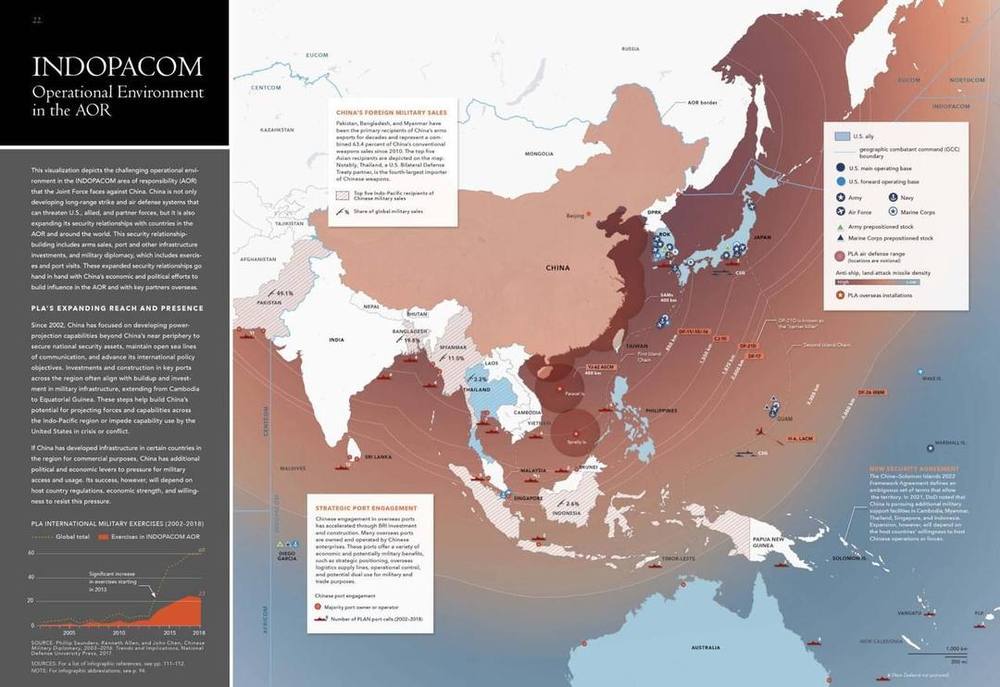
China's strategic depth and the clash of its interests with those of the United States in the Asia-Pacific
This infographic maps the complex operational picture in the INDOPACOM area of responsibility, where the United States confronts China.
This infographic maps the complex operational picture in the INDOPACOM area of responsibility, where the United States confronts China.
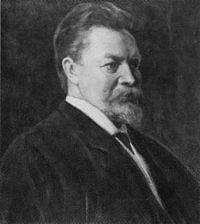
Rudolf Kjellén (1864–1922) was a Swedish geographer and political figure who considered himself a pupil of Friedrich Ratzel. His doctrine treated the state as a living organism and defined the great powers by three spatial factors.
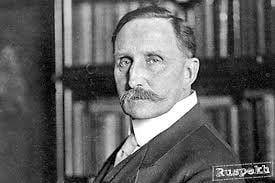
Karl Haushofer (1869–1946) was born in Munich, Germany, into a professor's family. He served in the army for more than 20 years and became the author of an original theory of the continental bloc and of pan-regions.
According to an IMF report, artificial intelligence affects occupations differently: some face a high risk of replacement, others are safe.
In the 1990s Europe, the United States and Japan made all of the world's semiconductors. Their combined share has since collapsed, while China has gone from 0% to 24%.
The Panama Canal is a lock-type waterway owned by Panama that links the Atlantic and Pacific oceans. It carries 2.5% of world maritime trade a year and 40% of US container traffic.
Birth rates have fallen to record lows across the West and Japan. In 2023 the EU recorded 3.665 million births, the fewest since records began in 1961, and the figure was down 5.5% on the year before.
Rudolf Kjellén (1864–1922) was a Swedish geographer and political figure who coined the term geopolitics. His doctrine treated the state as a living organism and ranked the great powers by space, cohesion and freedom of movement.
According to the International Federation of Robotics, 545,000 industrial robots were installed at factories worldwide in 2022. Asia took 74% of them and China alone 53%.
Friedrich Ratzel is regarded as the founder of geopolitics as a scientific discipline. His doctrine of the state as a living organism that must expand its living space justified German territorial expansion.
An aircraft carrier is a floating airbase that projects a country's military and economic power at sea. Eleven countries operate carriers today, and NATO members together with Japan have 20 between them.
This chart shows the countries that dominated shipbuilding by gross tonnage of merchant ships built in 2023, led by China, South Korea and Japan, which together account for 94% of the industry.
The Cold War divided the planet into three worlds; after the Soviet bloc collapsed, the concepts of the Global North and the Global South took shape.
A World Bank chart tracing the growth of the world economy over the past two thousand years. World GDP grew by just 20% in the first millennium but has doubled every 20–25 years in recent decades.
On 13 September 2024 the Bank of Russia raised its key rate to 19%, even as other major central banks were cutting. The increase is feeding through to mortgage rates, which have climbed above 21%.
According to the IMF, the combined GDP of the G7 reached $45.9 trillion in 2023, one and a half times the size of the BRICS economies.
Defence spending rose at its fastest rate in a decade in 2023, reaching $2.443 trillion worldwide, with NATO accounting for 55% of the total.
Saudi Arabia's decision not to renew its era-defining security agreement with the United States, the sale of oil for dollars, reflects both America's declining global influence and where most Saudi oil is now sold.
Bloomberg and IMF forecasts put China first for contributions to global growth in 2024–2029, ahead of the G7 combined, with India second and Indonesia third.
Saudi Arabia ranks 16th by GDP (PPP), and its oil wealth is managed by the state giant Saudi Aramco. The non-oil economy is now growing fast, even as hydrocarbons stay central to modern manufacturing.
Japan's Sixth Energy Plan targets 38% renewables and 20% nuclear by 2030, while coal and gas lose ground. Yet total power generation has been falling since 2010.