


Friedrich Ratzel's concept of Lebensraum and the world power
Friedrich Ratzel is regarded as the founder of geopolitics as a scientific discipline. His doctrine of the state as a living organism that must expand its living space justified German territorial expansion.
Friedrich Ratzel’s concept of Lebensraum and the world power
Friedrich Ratzel is considered the founder of modern geopolitics as a scientific discipline. Geopolitics as a science studies the interaction of countries or regions across the whole planet, taking geographical factors into account. It emerged at the turn of the 19th–20th centuries, branching off from political geography, and has been developing rapidly ever since. Ratzel’s main contribution was his attempt to link politics and geography, and to study a state’s politics through the geographical position it occupies.
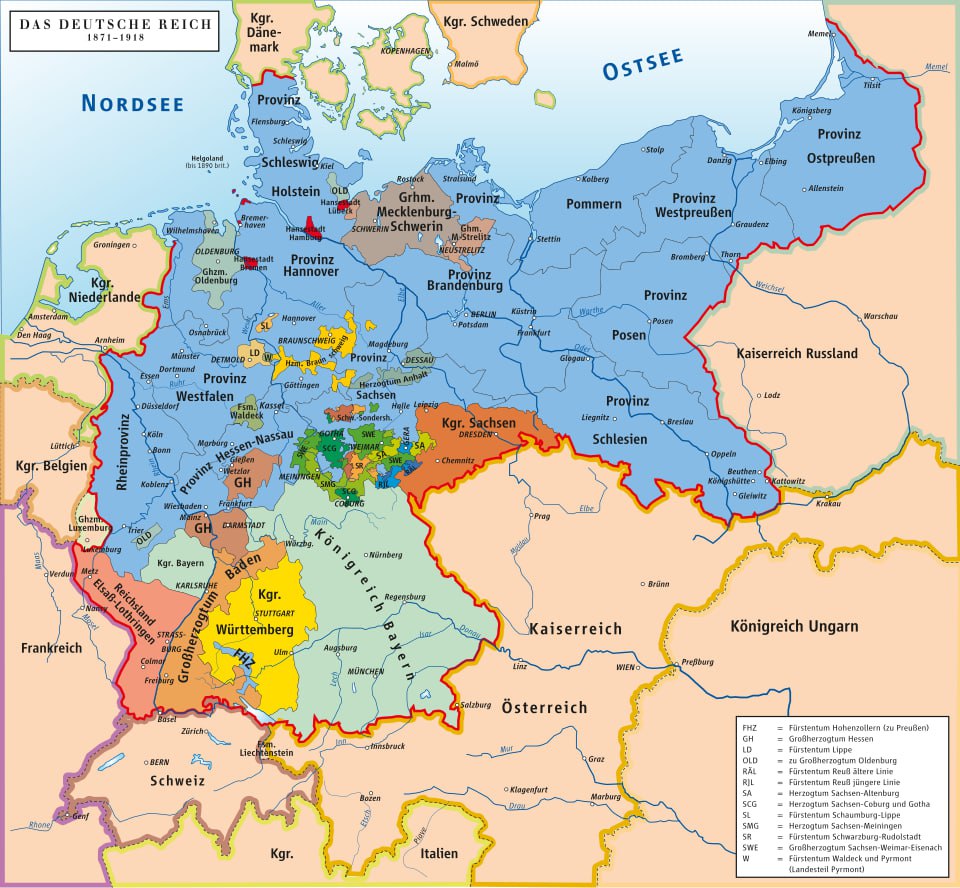
Ratzel wrote his main works on political geography — “The Laws of Spatial Growth of States” (1896), “Political Geography” (1897) and “The Sea as a Source of the Power of Nations” (1900) — which brought him worldwide fame. His geopolitical views were shaped by Charles Darwin’s theory of evolution (society is in a constant struggle for existence, in which the fittest survive) and by Chancellor Otto von Bismarck’s unification of many warring small principalities into a single German state (the German Empire) in 1871 (there were more than 300 principalities). The German Empire’s subsequent economic and military-political rise at the end of the 19th century led Ratzel to formulate his geopolitical doctrine.
Ratzel saw the globe as a single whole of which man is an inseparable part. He believed that man must adapt to his environment just as flora and fauna do. His geopolitical doctrine rests on his teaching that the state is a geographical and biological organism striving for constant expansion. A state’s essential characteristics are determined by its territory and location, and its condition and prosperity depend on how successfully it adapts to its environment. One of the main ways an organism (a state) builds its power is territorial expansion, or the expansion of its living space — Lebensraum.
Ratzel argued that a state’s prosperity rests entirely on the properties of its territory — its size, position, surface forms, vegetation and water supply, its relation to other parts of the earth’s surface, and everything man has made from that land by his labour (that is, the spiritual bond between the land and its people and their history). To exist, a state must secure sufficient living space for itself. Only a substantial space can guarantee a state a dominant position in the world. The struggle for power and dominance among other countries can turn a state into a world power (Weltmacht) and later lead it to world domination. Ratzel’s doctrine of course justified Germany’s territorial expansion, whose possibilities were constrained by borders too tight for its further dynamic development by the end of the 19th century.
Friedrich Ratzel’s concept of Lebensraum and the world power
By 1914 Germany had left France far behind and was already overtaking Britain in industrial output. In 1909–1913 Germany’s share of world exports was 12.2%, while the shares of France, Britain and the US were 7.5%, 13.5% and 12.7% respectively. At the beginning of the 20th century the world had been divided up mainly between the leading empires of the time: Britain, France and Russia. Other second-tier countries (Belgium, the Netherlands, Italy, the Ottoman Empire, Portugal) also held colonial territories. Among the major powers with serious industrial development, Germany held only a few colonies in the world — Tanzania, Namibia, Cameroon, Togo and some islands in Oceania. Britain, the largest empire in human history, for example controlled 31,878,965 km², or 22% of the earth’s land, by 1919. Including the colonies, Britain’s total population was about 480 million (25% of the world’s people). Germany therefore needed living space with new markets and resources for its continued existence and prosperity. These factors explain the roots of Ratzel’s geopolitical doctrine.
Ratzel argued that dynamic territorial growth distinguishes prosperous states from those prone to decline. A state’s decline results from a weakening “sense of space” and a decline in the people’s “life energy”.
He identified certain peoples endowed with a “sense of space” who strive to expand the territory they inhabit. Ratzel believed that none of the primitive peoples had created a large state, and that in future global weight would belong to large states occupying big continental territories such as North America, Russia, South America and Australia. The idea of expanding living space is central to his concept: “A people grows by increasing in numbers, a country by increasing the space it controls.” In Ratzel’s view, a state seeking to become a great power must have a territory of around 5 million km². Germany, for example, had about 550,000 km² by the end of the 19th century. Ratzel saw state expansion as a natural tendency in the development of the state-organism. He notes that the succession of hegemonic cycles since the 15th century ran in the direction of transferring dominance from smaller states to larger ones.
Friedrich Ratzel’s concept of Lebensraum and the world power
In “On the Laws of Spatial Growth of States” (1901), Ratzel set out seven basic laws of expansion, or the spatial growth of states:
-
Space grows with the growth of a nation’s culture (culture is very important in a state’s history).
-
The growth of the state is accompanied by the development of an idea (meaning a concept of the state’s development. Today no state has a comprehensive development concept for even the next 10–20 years. Russia is at the stage of developing such an idea, or project), of trade, missionary work and activity.
-
The growth of the state proceeds by annexing and absorbing small states.
-
The border is a peripheral organ of the state, in which its growth, its strength or weakness and all changes in the state organism are manifested. A strong state is one able to maintain close links between its border zones and its core. Any tendency to weaken that interaction will inevitably weaken the state and lead to the loss of the border zone, which may declare independence from the centre or join a neighbouring state.
-
In its growth the state seeks to absorb the most valuable elements of the physical-geographical environment: coastlines, river courses, plains and areas rich in natural resources.
-
The first impulse towards territorial growth comes to primitive states from outside, from higher civilisations.
-
The general tendency towards the merging of territories, branching out, passes from state to state and gathers strength. In their spatial expansion, states tend towards naturally closed configurations. Ratzel believes that this striving to grow into natural borders can be satisfied within the borders of continents.
In Ratzel’s view, the world’s geopolitical space is defined by the confrontation between continental and maritime world centres of power. He believed the decisive clash between these forces would take place in the zone of the “ocean of the future”, that is, the Pacific. He noted that five powers, including the US, Britain, Russia, China and Japan, would take part in the future struggle in the Pacific basin. On Ratzel’s account, the continental powers with their rich resources would have the advantage in that conflict over maritime powers, which lack not only sufficient space but also sufficient resources. Today India can be added to the list of countries that will take part in the struggle for control of the Asia-Pacific region.
That concludes Ratzel’s geopolitics.