


World GDP growth over 2,000 years
A World Bank chart tracing the growth of the world economy over the past two thousand years. World GDP grew by just 20% in the first millennium but has doubled every 20–25 years in recent decades.
World GDP growth over 2,000 years
This World Bank chart tracks the growth of the world economy over the past 2,000 years. According to the World Bank’s research, world GDP grew by just 20% over the first millennium, from $213 billion to $245 billion in 2017 prices. According to the UN, the population rose from 300 million to 310 million over the same period. Over the following 500 years the world economy almost doubled, to $502 billion, and the population grew to 580 million. For most of those centuries economic growth was linear and tied to population growth.
World GDP growth over 2,000 years
By the early 18th century the world’s population had reached 610 million, and by the start of 1804 it had reached 1 billion. From the second half of the 18th century, with the onset of the Industrial Revolution, world GDP began to grow intensively. The great Industrial Revolution began in England and later spread to France, Germany, Russia and the United States. In the second half of the 18th century England’s Industrial Revolution — the mass shift from hand labour to machines, from manufacture to the factory — started in textiles (cotton), then spread quickly through every branch of the economy and transformed the country’s social, economic and political life.
World GDP growth over 2,000 years
England’s great Industrial Revolution rested on fundamental technological innovations that appeared in the second half of the 18th century. In textiles the industry adopted Arkwright’s spinning frames (Richard Arkwright was a leading English entrepreneur of the Industrial Revolution and a pioneer of factory production), Hargreaves’s machine (the English inventor of the Spinning Jenny) and Crompton’s machine (the English inventor of the spinning mule, a periodic-action machine that revolutionised the textile industry). These inventions and their wide use in textiles produced a tenfold increase in yarn output and a rise in imports of raw cotton from the Antilles, the East Indies (a term once used for India and some other countries of South and South-East Asia) and, soon after, from the southern American colonies.
World GDP growth over 2,000 years
In England’s factories a water wheel drove a thousand spindles. Many of these enterprises employed 700–800 people. The rise of capitalist factories marked a decisive moment in the Industrial Revolution. Dependence on the power of falling river water later made it impossible to spread factories across the country and to grow large industrial cities. Expanding factory production required a new source of mechanical power. James Watt’s invention of the steam engine (1784) supplied it. The steam engine was the second innovation that made England’s Industrial Revolution possible.
World GDP growth over 2,000 years
The rapid expansion of production across every branch of English industry required ever more metallurgical products (pig iron, steel and iron), and industry therefore needed a new, reliable and cheap source of energy to replace charcoal. The third timely innovation, which consolidated the success of England’s Industrial Revolution, was the English metallurgist Abraham Darby’s invention of coal coke and its use in place of charcoal for smelting iron in the iron and steel industry. In my view this was probably the single most important cause of the Industrial Revolution and the factor that entrenched it in England. The economy needed cheap energy in metallurgy, and Abraham Darby supplied it. Coal coke came to be used not only for pig iron but also to make malleable iron and steel. From then on, smelting iron with coal coke became the foundation of all metallurgical production in the world. It transformed the metallurgical industry, which until then had consumed large amounts of charcoal and depended on shrinking forest resources, making it increasingly expensive. The new metallurgical industry was tied to coalfields. As a result, new, modern centres of heavy industry emerged.
World GDP growth over 2,000 years
Together, China and India accounted for about 60% of the world economy before the Industrial Revolution began in England and other European countries. China was the first country whose population reached 100 million, in the 1470s. India reached the same mark at about the same time. For nearly four centuries after that, China and India were the only countries with more than 100 million people. The technological order created by Europe’s Industrial Revolution allowed European countries to take the leading positions in the world economy. Steam engines running on coal, the cheapest energy source, came into use everywhere — in the building of locomotives and steamships, in metallurgy, in textile production and in other industries. Western countries began to seize world markets aggressively.
World GDP growth over 2,000 years
The Industrial Revolution that began in the second half of the 18th century continued through the 19th century. Its hallmark was the rapid growth of productive forces based on large-scale machine industry, which established capitalism as the dominant world economic system. Before the cotton revolution that launched the Industrial Revolution, for example, England lagged far behind India’s cotton industry. The task was to produce cloth as good as India’s but considerably cheaper. Mechanising the industry with Arkwright’s and Crompton’s machines and later with Watt’s steam engines not only met that goal but delivered fantastic growth in output and the conquest of world markets. In 1800 cotton cloth made up 25% of British exports; by 1850 it was half. In 1785 England produced 40 million yards of cotton cloth (a yard is 0.91 metres); by 1850 it produced 2,025 million yards.
World GDP growth over 2,000 years
Another factor behind the success of the Industrial Revolution in England and other European countries was the accumulation of primitive capital through the exploitation of colonies, capital that was invested in building countless factories and plants and so industrialised the Old World. Karl Marx captured this sharply in his day: “The treasures captured outside Europe by undisguised looting, enslavement and murder flowed back to the mother-country and were turned into capital there.”
World GDP growth over 2,000 years
England, unlike Holland, used this capital effectively to prepare for and carry out its own Industrial Revolution. Holland might perhaps have begun its Industrial Revolution earlier than England, but the Dutch elites chose to focus on finance — banking — and on intermediary trade rather than on domestic industry. The Dutch still work as intermediaries today, earning huge sums by selling LNG (liquefied natural gas) into Western Europe through their ports.
World GDP growth over 2,000 years
The 20th century stood out for the profound qualitative changes in the world economic system. Besides coal, which reshaped the whole of the 19th century, oil and gas, nuclear power and modern hydropower emerged as new energy sources. These new sources diversified modern energy and the world economy. The 20th century also saw two world wars, the collapse of the colonial system and the break-up of the socialist bloc and its economic system. These were deep changes that transformed the shape of the world economy. Where the market-capitalist system of the world economy comprised more than 160 countries in the mid-1980s, after the collapse of the USSR in 1991 the world became globalised: the capitalist system encompassed every country, even the few remaining socialist states, which operate by the rules of that system and perform their part in the international division of labour.
World GDP growth over 2,000 years
The essence of globalism is that an international division of labour exists and every country contributes its own small part to the world’s total work. This creates very long chains along which technical systems and technologies are produced and through which the final systems and goods reach the end consumer. This world system was founded on the free movement of labour and people, capital, technology, means of production and information. The world moved onto a new technological base dominated by information technology and the social-information environment. From the late 20th century a consumer system built on cheap credit also took shape, driving rapid growth in the world economy. Over the past century the world economy has doubled in size every 20–25 years. New forms of road transport, wired communications, satellite internet, modern ships and container, gas and oil carriers also underpinned that growth by delivering cheap energy to consumers and to producing economies, as did modern GPS navigation and so on.
World GDP growth over 2,000 years
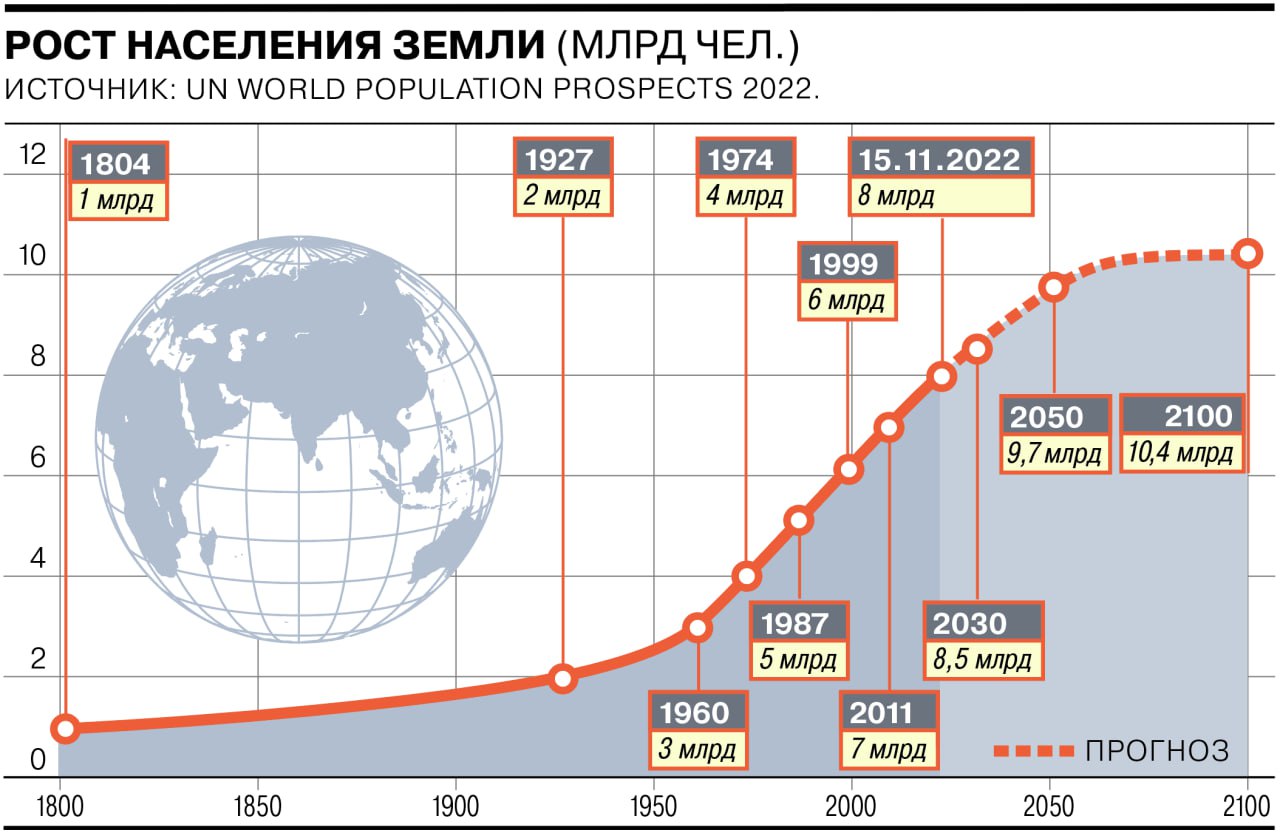
Alongside the growth of productive forces tied to Europe’s Industrial Revolution, which began in the second half of the 18th century, the world’s population grew markedly. It passed 2 billion by 1925. In the 20th century the planet’s population quadrupled, driven not only by the birth-rate surge itself but by a qualitative improvement in people’s lives, including better nutrition and advances in sanitation and medicine. Life expectancy rose substantially around the world. Population growth became a crucial factor in the hyperbolic growth of the world economy (as the chart above shows), alongside the growth of labour productivity. Yet the UN forecasts that the world’s population will not double again during the 21st century. By the end of the 21st century global population growth will fall to 0.1%, and the new balance restraining world population growth will be a low birth rate that keeps changes in the world’s population small. Every developed country in the world is now passing through this stage of the demographic transition. Predicting the rise or fall of the world’s population is very difficult. We shall live and see.
World GDP growth over 2,000 years
For almost two thousand years, right up to the early 19th century, when the great Industrial Revolution was unfolding across Europe and reshaping every sphere of European life, China and India were the world’s leading economies. Then the West seized the lead in the world economy on its new technological base. According to the IMF chart, China and India are now gradually reclaiming their places in the global economy, lost more than two centuries ago. These countries are building their economies on a new, more modern technological infrastructure. The European Union’s share of world GDP has fallen from almost 30% to 17.3% since the 1990s (in the early 1990s the EU economy was larger than that of the United States). China has almost drawn level with the EU, at 16.9%. In the 1990s Japan accounted for almost 18% of the world economy; its share has now fallen below 4%. India has become the world’s third-largest economy, overtaking Japan. History is changing.
World GDP growth over 2,000 years
The chart also shows that the European Union (an economic and political union of 27 countries) is losing share at the same rate Japan is. One of the key factors behind the decline of both economies is falling birth rates and ageing populations. Another is the burden of large public debts. Japan’s total government debt, for instance, stands at 252% of GDP — an enormous debt. The tax base of both economies is shrinking as the share of elderly people rises. The pace of scientific and technological progress has slowed in the EU and Japan. They have failed to restructure for the new technological order now taking shape in the world. The EU lost the global electric-car race to China, forcing it to raise tariffs sharply on Chinese EVs entering its market. If this continues, China and the United States will decisively take most of the EU’s and Japan’s share of world markets in the coming years. Competition between countries and blocs for world markets is very tough.